• Skip to main content

Levinson and Stefani Injury Lawyers

Client-first legal representation for injury victims. Injured? Free Consultation:

(312) 376-3812

  • Home
  • About Us
    • Attorneys
      • Ken Levinson
      • Jay Stefani
      • Vanessa A. Gebka
    • Practice Areas
      • Truck Crashes
      • Bus Collisions
      • Auto Accidents
      • Child Injuries
  • Firm News
  • Library
    • Articles
    • Cases
    • Law
    • Video
  • Blog
  • For Lawyers
    • Focus Groups
  • Free Case Review

trucking legislation

Republican Senator Requests Bipartisanship for Highway Legislation

June 10, 2021 by Levinson and Stefani Leave a Comment

Currently, federal policymakers are considering potential comprehensive highway policy legislation. In this case, bipartisanship is key, explained the top Republican on the United States Senate transportation committee, Senator Shelley Moore Capito of West Virginia.

Moore Capito also currently serves as the ranking member on the Environment and Public Works Committee.

According to her, the panel will only be able to come up with an effective and efficient multi-year highway policy bill that serves everyone involved if it has the necessary input from both republicans and democrats. The current premier highway law in place will expire in September of this year.

For support in the updating of the current law in place, republicans would need to see cooperation from lawmakers in regards to policy and funding belief differences. For example, House and Senate majority democrats have explained that the modernization of all transportation systems would have to come at the hands of particular transportation legislation that focuses strongly on helping to ease the effects of climate change. For Republicans, surface transportation corridor repair-focused legislation is the most important subject needing legislation consideration.

In terms of transportation program funding, neither republicans nor democrats have approved any potential method or strategy.

“We need the give and take of this bipartisan process to produce legislation that can make it to the president’s desk,” explained Moore Capito earlier in Spring. “It will take work from all levels of government and the private sector to meet the nation’s transportation infrastructure needs. We will have to take an all hands on deck approach.”

Moore Capito is looking to find the securement of long-term funding for highway systems across the nation, and plans to back the allocation of resources for infrastructure technology enhancement across all areas of the sector. Additionally, she is currently proposing a potential highway bill that would boost connectivity along freight corridors, enhance transportation project safety and capacity, and boost commuter mobility options for all methods of travel.

Republicans and democrats alike have been concerned about the overall longevity of the Highway Trust Fund, which relies on federal fuel tax revenue and aims to help state transportation agencies in regards to construction, repairs, and upgrades among bridges, transit, and roads. For what is currently needed in these regards, the 24.4 cents-per-gallon diesel tax and 18.4 cents-per-gallon gas tax revenue will not be enough. 

The general fund has had to cover shortages from the trust fund’s revenue since 2008.

“Funding our infrastructure should not be a political battle,” said House Transportation and Infrastructure Committee ranking member, Sam Graves. “It’s time to set a definitive path toward the long-term sustainability of the Highway Trust Fund, a path that is totally funded by all users of the system and not by insufficient gas taxes and deficit spending. This is how we realize the transformative projects everyone wants to accomplish.”

Moore Capito is also receiving support from other senators, especially for the updates needed in the United States’ highway legislation. Senator Tom Carper of Delaware noted that he plans to set in place a potential highway bill that would likely be implemented sooner than later. Carper also currently serves as the panel’s chairman.

“We’re told that the average number of years a vehicle has on the road is about 15 years, so we’re going to be using gas and diesel for some time, but by less going forward,” Carper explained. Because of this, the panel has been looking to implement alternative revenue streams that would be user-based and able to bring in further transportation program funding.

The trust fund’s shortcomings are only getting worse, many stakeholders have claimed. This deficit could even lead to late payments for completed work in many states.

“Unless additional revenues or transfers are authorized, the [Highway Trust Fund] could diminish to the point that the U.S. Department of Transportation may have to delay payments to states for completed work,” explained National Conference of State Legislatures transportation program director, Douglas Shinkle. “Late payments or reduced federal transportation spending to accommodate for the shortfall is not an option for states.”

To fund portions of his $2.25 trillion infrastructure plan, President Joe Biden has proposed a corporate tax rate raise from 21% to 28%. This kind of funding would hopefully eradicate the need for a potential national vehicle miles travel fee that would charge motorists for each mile they drive.

“Fundamentally, he does not believe that paying for this historic investment in rebuilding our nation’s infrastructure and creating millions of jobs should be on the backs of Americans.” said Jen Psaki, White House Press Secretary.
$7 Million Dedicated to Illinois Truck Traffic Projects

June 8, 2021 by Levinson and Stefani Leave a Comment

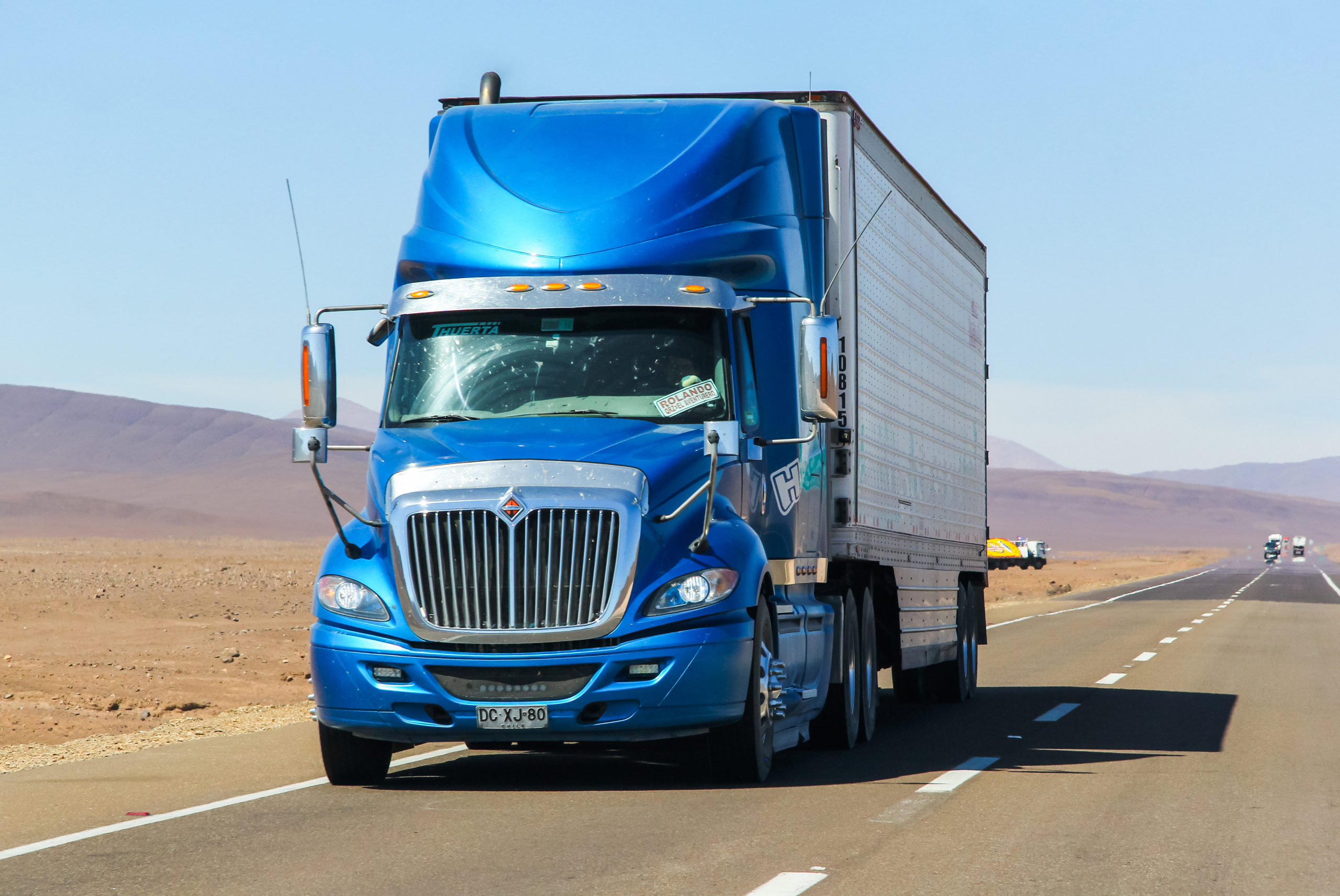
ATACAMA, CHILE – NOVEMBER 14, 2015: Semi-trailer truck International Navistar at the interurban freeway.

“Illinois is the country’s transportation hub, with freight activity a cornerstone of the state’s economy,” said Omer Osman, Secretary of the Illinois Department of Transportation. “At IDOT, we want our local partners to have the necessary tools to manage traffic safely and spur even more job creation and economic growth.”

$26 million has been allocated to 21 different transportation projects throughout Illinois, with IDOT distributing $7 million to projects specifically working to boost infrastructure and upgrade Illinois truck traffic accommodations.

“IDOT has awarded $7 million to put toward a total investment of $36 million for communities to better handle truck traffic and spur economic growth,” said IDOT Illinois recently in a tweet.

These funds come from IDOT’s Truck Access Route Program grants, an initiative calling for all towns, counties, and municipalities needing road upgrade assistance in regards to the transitioning of roads into designated trucks routes (that can accommodate heavy trucks) to apply.

According to Illinois Governor J.B. Pritzker, this funding is meant to ensure local communities have everything needed to better manage economic growth, attract more business, and improve the overall quality of life of their locals.

Projects aiming to improve designated truck route-to-business connections in efforts to boost freight traffic can receive a maximum of $900,000, IDOT explained. To apply for a grant, interested groups should list traffic figures, the number of lanes involved, and the length in both feet and miles of the project as a whole.

Out of the most recent funding, $900,000 was allocated to Champaign County, whose funds will help its County Highway 20, a north-south stretch connecting to U.S. 45 and reaching from Lake Superior to the Gulf of Mexico. $651,000 was awarded to DeKalb County, a northern Illinois town 60 miles west of Chicago, which is working to upgrade Chicago Road and its connection to Route 23. Williamson County is receiving $250,000 for its Thompsonville Road, a route connecting Corinth Road with Locust Grove Road.

Boone County is also receiving $630,000 for its Poplar Grove Road connecting the City of Belvidere to the Village of Poplar Grove, La Salle County is receiving $518,400 for its County Highway 2 connecting U.S. 34 with U.S. 52, and McLean County is receiving $366,300 for its County Highway 24 and $517.000 for its Meadows Road connecting 2555 North Road to U.S. 24.

Additionally, a Franklin County project regarding County Highway 14 was given $318,500. Franklin County is 100 miles southeast of St.Louis and reaches around the bottom half of Rend Lake, and County Highway 14 connects to north-south southern Illinois route SR 148.

Rebuild Illinois was initiated in 2019 as an infrastructure improvement initiative that would work to invest in the improvement of transit, roads, bridges, state parks, historic sites, clean water infrastructure, and education, and Pritzker announced recently that $250 million of these funds would be dedicated to Illinois transportation projects.

For county, town, and municipality-focused projects, $1.5 billion was also allocated by Rebuild Illinois. These grants will be distributed evenly throughout six installments over the next three years to local government agencies. In March, IDOT sent the third of its six $250,000 million installments as part of the overall multi-year, $33.2 billion capital program.

A job-training program was also announced by Pritzker, along with the Illinois Department of Commerce and Economic Opportunity. This effort has been created in collaboration with the Association for Supply Chain Management and aims to boost the recently unemployed or underemployed due to challenges faced throughout the coronavirus pandemic.

The job-training program is also meant to find methods of helping Illinois locals better understand and utilize the exponential growth of logistics, shipping, and e-commerce across the state–especially that which skyrocketed during the nation’s stay-at-home orders.

To funnel funds to Rebuild Illinois, the state’s fuel tax rate did increase in 2020 after doubling in 2019, with current fuel tax rates coming up to 46.2 cents per gallon for diesel and 38.7 cents per gallon for gasoline.

Potential Infrastructure Package Brings Stakeholders Together

June 6, 2021 by Levinson and Stefani Leave a Comment

Members from all areas of the transportation industry have come together to urge Capitol Hill to take action in the wake of lawmakers’ intent to take into account a $2.25 trillion infrastructure plan, proposed by President Biden and set to be under official consideration very soon.

Because needs for boosting the nation’s infrastructure system are well-known throughout environmental groups, labor organizations, advocacy firms, businesses, and freight industry organizations, stakeholders from across all these areas are agreeing on the benefits surrounding a potential multi-year highway policy bill.

Although many industry members have failed to reach overall agreement on the president’s American Jobs plan–especially due to worries regarding Democrats’ current control in the White House, House, and Senate–a comprehensive infrastructure plan that would involve a multi-year highway policy plan is clearly a positive for nearly everyone.

“[I’m] glad to see [the] White House push for action infrastructure,” said vice president of transportation infrastructure for the U.S. Chamber of Commerce, Ed Mortimer. “[I’m] not sure whether that means [an] American Jobs [Plan] package or surface transportation [highway policy] authorization. [I] expect them to move separately.”

A Bipartisan Policy Center- and U.S. Chamber of Commerce-led coalition is pushing for an infrastructure package focusing on updates and repairs to be passed by the fourth of July. Such a project, they say, could lead to a variety of lasting employment opportunities and create a much-needed economic boost for the country as a whole.

“Today, we joined BPC Bipartisan and over 300 national and local [organizations] in sending a letter to Congress urging them to enact an infrastructure package by the 4th of July that stimulates the economy and improves quality of life for all Americans,” said the U.S. Chamber recently in a tweet.

The American Public Transportation Association, the Laborers’ International Union of North America, the Transportation Intermediaries Association, and the Natural Resources Defense Council are a few of the more than 300 groups that have joined hands to form the coalition since March.

Additionally, the American Road and Transportation Builders Association, along with the Associated General Contractors of America, is co-chairing the Transportation Construction Coalition. This organization will work to light a fire under those who can make moves in regards to the infrastructure package, especially as many stakeholders are claiming that comprehensive infrastructure plans will bring major boosts to the economy.

“The president’s plan will accelerate a long-overdue conversation about how to modernize our roads, bridges, public transit, and other infrastructure systems,” explained Dave Bauer, CEO and president of ARTBA. “Members of Congress from both parties will rightly have their own policy throughs. The most important thing is not whose plan passes Congress, but that at the end of the process, the American people have increased mobility, and the competitiveness of the U.S. economy is strengthened.”

Biden’s plan, which would bring $115 billion for highways and bridges, $85 billion for transit, $80 billion for Amtrak, $25 billion for airports, and $17 billion for inland ports, is being pushed heavily by the White House for Congress to sign into law. Biden has also mentioned that corporate tax rates would need to raise an additional 7% in order for the measure to be fully funded.

Many groups and organizations involving agriculture, autonomous technology, and rural housing have also made known their support for this plan. Although these industries’ stakeholders have previously argued over potential transportation policies and overall budgets, they are now finding agreement due to the plan’s potential in bringing massive transportation legislation through Congress.

“We have been talking about an infrastructure package for years and it has never gotten past a talking point,” noted Beth Osborne of Transportation for America. “This seems to be the most serious effort yet, but when and how it comes together depends on how open the various factions on Capitol Hill are to making a deal.”

Osborne also added that the president’s plan could allow for funding to come through in regards to climate change, racial equity, and pedestrian, bicycle, and motorcycle transportation.

“The only thing that matters is whether we are funding projects that restore infrastructure in need of repair, [improving] roadway safety after one of the most deadly years in decades, and [providing] Americans with access to jobs and essential services whether they can afford a car or not,” she said.

Latest Safety Concern List Adopted by NTSB, GAO Calls for Deeper Look

June 6, 2021 by Levinson and Stefani Leave a Comment

A wide range of safety improvements and updates need to be implemented across all modes of transportation, according to the latest Most Wanted List of safety concerns, recently released by the National Transportation Safety Board.

The list for the year 2021-2022 still mentions some of the recommendations made in 2019, such as the need for an industry-wide mandate in regards to how to install collision-avoidance technology into commercial motor vehicles.  The latest list also included the need for an efficient strategy related to methods of speeding-related collision elimination, distracted driving prevention, and the eradication of drug- and alcohol-impaired driving.

“The Most Wanted List defines the focus of the NTSB’s advocacy work,” said Chairman of NTSB, Robert Sumwalt. “It directs our limited advocacy resources toward improvements with the greatest potential to make the greatest impact on saving lives, reducing injuries, and preventing accidents and crashes.”

NTSB, an agency that works independently and aims to identify the factors feeding into roadway accidents and the best ways to implement safety solutions, unanimously adopted this most recent “Most Wanted List,” a decision which came after more than four hours of discussion, question-and-answer sessions, and staff presentations.

Every single member of NTSB’s board–currently only five people in total–must be confirmed by the Senate following their nomination by the president.

The final approval of this Most Wanted List by the board, and the recommendations that accompanied these major concerns, were “driven by data,” according to Sumwalt, who also added that all of these problems are currently “ripe for action.” Everything included in the Most Wanted List incorporated aspects of NTSB’s own research and investigations, he noted–especially data collected in regards to roadway incidents which involved impaired driving or speeding.

NTSB’s Office of Highway Safety director, Robert Molloy, noted that these are the crash causes that typically lead to the nation’s fatal accidents.

“Studies have shown that as many as 80% of crashes could have benefited from sensor-based collision-avoidance technologies, such as automatic emergency braking and forward-collision warning,” Molloy explained. “All vehicles should have these systems available as a standard feature.”

NTSB’s most recent meeting, which involved presentations on investigations into previous accidents, came as a response to the issues regarding transparency that were brought to light by the Government Accountability Office. In 2020, GAO urged NTSB to thoroughly document all evaluations for every single concern mentioned on its Most Wanted List, and added that all criteria utilized for determining any issue as being “ripe for action” should be efficiently explained and communicated to the public.

If these efforts are not executed properly, the concerns on the list could fail to receive any sufficient solution-oriented efforts, according to GAO.

“If advocacy groups, industry associations, and others don’t know why NTSB is advocating for these particular safety issues and recommendations, that could affect their attention to and support for tackling the issues on the list,” GAO explained. 

Additionally, to truly bring to light the problems on these lists that have been nationwide concerns for far too long, full explanation and communication with the public and industry members is key.

“Greater transparency in how issues are evaluated and selected could enhance users’ understanding of the list and help ensure the list continues to rally the support and resources needed to tackle difficult and long-standing transportation safety challenges.”

The discussions like these that take place during these board meetings, Sumwalt noted, always aim to lead to extensive and productive deliberation and problem-solving. He hopes that anyone who observed this most recent meeting–or any meeting of the board–can see that these discussions are indeed meant to be as productive as possible.

“If anybody thinks these board meetings are scripted, then you hopefully have seen the board actually [active] in our deliberations.” he said. “Nothing is pre-decisional. What you saw was our deliberations.”

Also on 2020-2021’s list of most-wanted improvements are: “vulnerable road user” protection efforts–especially for motorcyclists, cyclists, and pedestrians; pipeline leak detection and mitigation improvements; rail worker safety upgrades; and passenger and fishing vessel safety improvements. Also needing major boosts, as mentioned by the list, are safety management technology installation on passenger-carrying flights, crash-resistant recorders, and programs regarding flight-data monitoring.

New Bill Aims to Finally End Distracted Driving for All

June 4, 2021 by Levinson and Stefani Leave a Comment

Distracted driving is an issue for everyone who shares the road, and cellphone use while operating a commercial motor vehicle or while driving near a truck can lead to fatal accidents.

Because of this, American Trucking Associations has formally expressed its support for a federal bill that would work to end the usage of cellphones while driving for all drivers–passenger vehicle drivers and truckers alike.

In February of this year, the Safe to Drive Act–a bipartisan bill–was introduced to the House and the Senate. The legislation would allocate up to a quarter of the U.S Department of Transportation’s funds within national priority safety program grants to states that can show they have set forth a statute regarding distracted driving that: can be used for drivers of any age, bans any handheld cellphone use or handheld use of any personal communication device while driving, and ensures that the violation of said statute is a primary offense.

“The trucking industry knows all too well the dangers of distracted driving and the threat it poses to all motorists, not just our professional truck drivers whose workplace is our nation’s roadways,” said Dan Horvath, Vice President of ATA’s Safety Policy, in a recent letter to transportation leaders in both the House and the Senate. “Ensuring all drivers are educated about the dangers of distracted driving, and effective enforcement of common-sense highway safety laws, will greatly aid our shared goal of zero highway fatalities.”

While many may assume that accidents involving a passenger vehicle and at least one truck due to distracted driving may be the fault of a trucker, Horvath noted that typically, these incidents are caused by dangerous behavior demonstrated by passenger vehicle drivers.

“Although 70 percent of fatal crashes involving a large truck and passenger vehicle are initiated by the actions of, or are the fault of, a passenger vehicle–there is now federal law preventing passenger vehicle drivers from using handheld mobile devices while driving,” he said. “Our nation’s professional truck drivers see distracted drivers all the time, and, unfortunately, no level of defensive driving can prevent all accidents from occurring.”

Current federal mandates restrict truck drivers from operating vehicles while using any handheld devices at any time–even while stopped at a traffic light.

“Given data showing the majority of car-truck collisions are the result of passenger driver behavior, extending those bans to all drivers and not just truck drivers will have a positive impact on safety,” Horvath added.

According to ATA, the Safe to Drive Act will be a “tremendous opportunity” for the country and the transportation industry to focus upon and allocate helpful resources to all accidents that are so often caused by distracted drivers–the kinds of accidents that can be hard for a truck driver to avoid.

“In commercial trucking, we require drivers to keep their eyes on the road ahead at all times–and we should expect the same vigilance of every motorist on the road,” said Horvath. “Sadly, convenient access to social media and streaming services has only increased the number of potential road hazards, leading to increases in the quantity and severity of distracted driving incidents.”

In fact, many truck drivers are incredibly surprised–and horrified–to learn about how often distracted driving really occurs on the road and how tricky it can be to anticipate the accidents that may accompany those distractions.

“I have seen everything from texting, to putting makeup on, to even reading a newspaper while driving,” said YRC Freight truck driver, Steve Fields. “Taking your eyes off of the road for just two seconds compromises highway safety. Anything we can do to reduce distraction is a good thing.”

This legislation’s co-sponsors hope that this kind of bill will help bring an end to these easily avoidable dangers once and for all.

“When drivers take their eyes off of the road, they endanger themselves, other drivers, and pedestrians,” said Senator Amy Klobuchar. “This legislation will help ensure states have the resources to create safer roads for all and ultimately, save lives.”

The number of deaths in accidents that involved distracted drivers made up 8.7 percent of all roadway deaths in 2019–a total of 3,142 fatalities at the hands of cellphone use or other distractions while operating a motor vehicle.

“This represents an increase of 284 fatalities than the previous year–an increase of 9.9 percent,” Horvath explained. “This trend is unacceptable for highway safety. Although numerous factors contribute to highway crashes, driver distraction as a result of mobile devices is not accidental. Moreover, it is completely preventable.”

New Smog Test Regulation Proposal Brings Strong Opinions from Fleets

June 3, 2021 by Levinson and Stefani Leave a Comment

In a recent informational workshop, it appeared that many trucking industry employees are not satisfied with California’s latest proposal–a maintenance program set forth by environmental regulators to update smog inspections for heavy-duty trucks that will mandate that carriers give their fleets quarterly smog tests, as opposed to the current requirements of annual inspections.

This proposal brings about the first potential requirement for motor carriers to submit smog tests upon crossing over the California border–whether or not they are domiciled in California. However, this regulation would also call for extra time to be offered to carriers in order for them to complete necessary truck reparations if they are found to be non-compliant and are operating up to three trucks.

Still, though, the final rule is not set to be considered by the California Air Resources Board until December of 2021, and CARB staff has explained that there is still much to be done in regards to perfecting the regulation, which would likely not be fully implemented until 2023.

This proposed regulation was first explained in California’s Mobile Source Strategy of 2016 and the state Senate Bill 210, which became law in 2019. Its primary goal is to ensure the high-quality maintenance of trucks’ emissions control systems and to better determine which vehicles may have malfunctions in their emissions control components so that quick and efficient repairs can be made. If these reparations are made in a timely manner, they can help to decrease the overall in-use of nitrogen oxides and the particulate matter emissions that come from non-gasoline, heavy-duty trucks weighing in at more than 14,000 pounds.

From these smog tests, data could be collected throughout the state of California at quick-stop testing sites at places such as at truck dealerships, or even through in-vehicle data diagnostics programs.

According to CARB air pollution specialist Krista Fregoso, this recent workshop came as a follow-up to answer questions from two previous meetings.

“Staff has revised the regulatory concepts based on stakeholder feedback and redrafted the concepts as draft-proposed regulatory text,” the announcement for the workshop explained. “The meeting discussion will focus on key updates to the concepts discussed at the December and February meetings.”

Some workshop participants asked if bigger fleets would have to report smog test results particularly quickly and if the schedule for the implementation of this kind of regulation was too demanding.

“For our organization, we hired nearly 8,000 sub-haulers as defined by the advanced clean fleet rule,” said J.B. Hunt Transport’s director of maintenance and equipment procurement, James Cottingham. “Those 8,000 sub-haulers represent roughly 308,000 pieces of equipment. How do you expect us to validate certificates for each and everyone of those trucks? It seems rather impossible.”

Because CARB board members are still working on gathering public feedback and working to find the best manners in which to help fleets adhere to these guidelines, the board asked for more insight from trucking companies.

“We’re still getting feedback on that,” said CARB air resources supervisor Cody Howard in response to Cottingham’s question, “and we would like further feedback from your group as well.”

The biggest worry for most of these fleets–rapidly increasing costs that could come from compliance to this regulation.

“Most people can relate to a smog check where they take their car in annually or maybe even less,” explained California-based environmental research for American Trucking Associations, Mike Tunnell. “But CARB has come up with the idea that they want to do it for trucks on a quarterly basis. According to CARB, only 3% of the trucks contribute 65% of truck-related particulate matter emissions, while for oxides of nitrogen, its 11% of the trucks contributing 47%. So, as we have seen with smog check programs in general, it becomes a matter of how well the program can identify malfunctioning vehicles while minimizing costs across the majority of vehicles which are compliant.”

Minimizing these costs is especially important for independent owner-operators, as well, explained president of Nisei Farmers League out of Fresno, Manuel Cunha Jr.

“The independent small trucker has it very, very difficult,” he said at the workshop. “If you’re going to make that small independent trucker go out and buy a $180,000 truck, and he only travels two or three months in California, [that] makes it even more difficult.”

CARB plans to have a back-office database where submissions for these smog tests can be stored, and on pre-OBD trucks, tests will be able to be run through a mobile testing device that comes from a third-party.

“The easiest way to seamlessly transfer the data would be through new software for the telematics systems many trucks now have,” explained Kenworth Truck Co.’s director of fleet management, Doug Powell.

  • « Go to Previous Page
  • Page 1
  • Interim pages omitted …
  • Page 7
  • Page 8
  • Page 9
  • Page 10
  • Page 11
  • Interim pages omitted …
  • Page 23
  • Go to Next Page »

Levinson and Stefani Injury Lawyers in Chicago / Attorney Advertising