• Skip to main content

Levinson and Stefani Injury Lawyers

Client-first legal representation for injury victims. Injured? Free Consultation:

(312) 376-3812

  • Home
  • About Us
    • Attorneys
      • Ken Levinson
      • Jay Stefani
      • Vanessa A. Gebka
    • Practice Areas
      • Truck Crashes
      • Bus Collisions
      • Auto Accidents
      • Child Injuries
  • Firm News
  • Library
    • Articles
    • Cases
    • Law
    • Video
  • Blog
  • For Lawyers
    • Focus Groups
  • Free Case Review

Vehicle Safety

Car Safety Ratings Will Now Include How Systems Keep Drivers Alert

February 10, 2022 by Levinson and Stefani Leave a Comment

As the transportation industry works to find ways to keep drivers alert while on the road, two particularly influential groups will start rating vehicles on how efficient their driver behavior-tracking systems are.

For vehicles using partially automated driver-assist systems, the ratings will become part of the overall scores for new vehicle models starting in 2022, according to the Insurance Institute for Highway Safety and Consumer Reports, both of which many car buyers seek out for vehicle safety judgments.

“The Insurance Institute for Highway Safety is developing a new ratings program that evaluates the safeguards that vehicles with partial automation employ to help drivers stay focused on the road,” said the institute in a tweet on January 19th, when the groups announced their new rating methods. This safety rating comes as more and more new vehicles are becoming equipped with automated safety systems.

These systems have had tendencies to make mistakes while drivers often fail to take swift action, leading to serious accidents. According to the groups, recent studies show drivers typically rely too heavily on their automated systems even though they are only partially automated. Additionally, vehicle advertising often overexaggerates the abilities of the systems, according to both groups.

IIHS and Consumer Reports noted that this new move was motivated by a concern over the lack of standards and ratings from the National Highway Safety Administration; NHTSA explained that it is still finding ways to analyze driver data and monitoring systems to set benchmarks in place.

Partially automated systems typically consist of lane-centerting technology, radar sensors, camera monitoring, and advanced cruise control, although the quality of these systems varies between different vehicles. Still, drivers may often ignore the alerts from their monitoring systems, especially when they’re referred to as “autopilot,” such as within Tesla models.

Tesla launched its “autopilot” driver-assist system in 2015, and a driver in a Tesla operating on the system was killed in a collision with a freeway barrier in Mountain View, California in 2018. The driver, according to the National Transportation Safety Board, was likely playing a game on his or her cellphone at the time.

“Autopilot” is easily considered self-driving, although no self-driving cars are currently available on the market, and all drivers must remain alert and aware at all times behind any wheel.

“Keeping drivers focused on the road and the vehicle is critical for the safe use of partially automated driving systems,” said IIHS president, David Harkey.

Some carmakers with partially automated systems onboard, including Ford, General Motors, and BMW, have cameras installed that monitor whether or not a driver’s eyes are on the road, while others may only look to see if a driver’s hands are present on the steering wheel. According to IIHS and Consumer Reports, the lack of federal standards means monitoring can easily be turned off or ignored.

If a driver decides not to pay attention to these monitoring systems, it could make driving even more dangerous than it would be while driving without any partially automated driving system onboard at all, noted Harkey.

“There are studies that go back probably 80 years that show humans are pretty bad about just watching automation happen,” said senior director of Consumer Reports’ Auto Test Center, Jake Fisher. “It’s just too easy to get bored and let your attention wander.”

There are currently no partially automated driving systems that meet IIHS’ standards, Harkey noted. Monitoring systems must have a variety of alerts available to remind a driver to keep his or her eyes on the road and to make sure the driver’s hands are on the steering wheel at all times, and the system must slow or stop the vehicle if a driver doesn’t respond to the alerts. All of these features must be in place for IIHS to give the vehicle a “good” rating.

“We’re hoping, and we think, that the automakers will respond, and they’ll start to add more robust features into their vehicles that have these systems,” added Harkey.

Communication and Safety Culture Key to Retaining Safe Drivers, Industry Leaders Say

January 25, 2022 by Levinson and Stefani Leave a Comment

“These are professionals, from day one, [with whom] we emphasize they are the captain of the ship and we trust them to use their judgment and experience to make the call to shut down [if needed],” said executive vice president of U.S. Truckload for TFI International, Greg Orr. “They trust us to provide them with the equipment, training, and support to be as safe as possible.”

For carriers like TFI, a solid safety reputation is vital for recruiting and retaining experienced drivers, especially as new technology continues to make its way into truck cabs across the country.

Because of this, continuous and proactive safety training efforts allow veteran drivers to continue improving their skills and habits while also allowing newer drivers to build their safe driving behaviors. Applying telematics and recording device insight and data to training processes, along with regular driver feedback and input, has made the continual training methods in place easier for many carriers, such as Estes Express Lines.

For the LTL carrier, this kind of technology brought some hesitation among drivers, but thorough communication helped put minds at ease, according to the company’s vice president of safety and risk management, Curtis Carr.

“We went on a road trip to many of our terminals and met with our drivers to explain what we were doing and why, how it would work, and how it would help them,” he explained. “We told them what we’d be measuring and the parameters for what events [the software] would track.”

Once guidance and coaching were made commonplace with such new technological advances coming to the cab, drivers began lessening their opposition to the changes.

“It’s just like a football coach,” said Carr. “These are the game tapes we are studying. If there’s something you’re doing well, keep it up. If there’s something we can improve, let’s work on it. We bring coaching opportunities to the driver’s attention in a positive, encouraging environment.”

Additionally, drivers want to know that all equipment at hand is maintained properly and is modern enough for regular use in today’s supply chain, noted Bettaway Supply Chain Services president, John Vaccaro.

“Nobody wants to break down, he said. “It’s our job to give them a truck that’s properly maintained so they can turn the key and go without any safety issues. It’s the driver’s job to do a thorough pre-trip, and if something comes up, [to] flag it so we can fix it before he goes out and point out anything when he comes back in.”

Still, drivers need to know the huge safety boosts that come with collision avoidance technology, in-cab cameras, and other innovative technological systems, Carr noted.

“What’s better than stopping a truck before an accident can occur?” he asked. “It’s been nothing but a great tool to help us defend our drivers from false claims and coach them in a positive manner [on] how to improve their skills and become even safer. I can’t understand operating a fleet those days who would not have a drive-cam.”

Most important, though, is a carrier’s overall culture of safety, explained vice president of safety and risk for Pitt Ohio, Jeff Mercadante.

“They know we put safety first,” he said. “We are ethical–we won’t have them break the rules in any way. Attitude and work ethic are everything. Our job is to provide the necessary training and provide the best equipment with the latest safety technologies so they can do their jobs safely.”

When drivers at CFI–a truckload carrier at which Orr also serves as president–were asked why they decided to drive for that particular carrier, most brought up the company’s exemplary safety record.

“Seventy percent answered that they’ve read reviews about us and how we emphasize a ‘captain of the ship’ mentality,” Orr said. “They watch videos and talk with other drivers. That’s the best endorsement we can ask for.”

Carrier leaders should also always prioritize personal connection with drivers and be willing to hear their worries and opinions on any given safety matter, Orr added.

“That’s really the key–staying connected with that driver, resolving issues, [and] being there for them at all times,” he said. “At the end of the day, they want to be safe and we give them the support, responsibility, and accountability to do that.”

More Than Ever, the Trucking Industry Expects Extremely Fast Repair Times

June 11, 2021 by Levinson and Stefani Leave a Comment

“The unanimous customer feedback was that every hour–and sometimes every minute–counts when it comes to uptime,” said Aftermarket senior vice president, Stefan Kürschner. “This is why we evolved our commitment to 24 hours or less–because it’s what our customers need to operate their businesses, and it’s what they need to satisfy their customers.”

Kürschner is referring to the changing standards when it comes to commercial truck repairs or maintenance–because for trucking companies, time is more valuable than ever.

For example, Daimler Trucks North America used to have a promise that it would be able to repair vehicles in three days or less–which wasn’t nearly quickly enough.

Peterbilt has also tightened its maintenance times with an overarching goal of averaging only 24 hours for repair. According to the company’s director of after sales, Bruce Croker, Peterbilt collaborates with dealerships to stick to this goal. A dealership can qualify for the company’s Platinum Program if they have an average time of 2.5 days or less for their own repairs.

To make these quick turnarounds possible, Peterbilt has implemented innovative communication tools and data flow capabilities in an effort to ensure its customers are receiving regular updates in regards to their repairs, and so that it can efficiently monitor the repair process to see right away if any approval or maintenance issues take place at any of its dealer locations. Peterbilt currently operates at 400 different sites.

“There’s lots of things that happen in a service event, and any one of those can slow down things to a crawl,” Croker explained. “So we’re data mining like crazy to work on our bottlenecks.”

The parts distribution sector of the industry is also seeing the effects of these changing standards, explained Rush Enterprises truck dealerships’ managing vice president of operations, Mike Eppes.

“When Amazon and others are delivering next-day or even same-day, that becomes your expectation in your business world as well,” Eppes noted.

For the best–and fastest–customer experience, Rush has ensured customers can order parts any time of day and hold their place in line for when warehouse employees show up. The company has also invested in route optimization for all of its delivery trucks to be able to reach customers as quickly as possible.

Additionally, Rush is utilizing an innovative call center system. This system is able to analyze data in a way to leverage these analytics to meet the needs of all customers in the most efficient way. Dwell times have also seen major reductions thanks to mobile repair capabilities–with 500 mobile technicians now part of the Rush team, explained the company’s vice president of service, Victor Cummings.

USA Truck’s vice president of maintenance, Jeff Harris, explained that other aspects of the trucking industry are undergoing changes in repair time expectations. USA Truck has quick time out estimations for all its equipment.

Hours-of-service requirement updates have also made these companies feel further pressure when it comes to repair times. If a fleet loses time, it loses money just as quickly.

“Operations is just waiting on you,” Harris said. “They just want to know when you’re going to have it done, and do they need to make a move with the driver?”

Because of this, USA Truck is utilizing capabilities to internally and externally track repair times, and ensure that it doesn’t need to wait on any other fleets.

P.A.M. Transport has never set a 24-hour benchmark, but aims to just get all repaired trucks back on the road as soon as possible. The express triage lanes of dealers have helped overall uptimes, P.A.M’.s vice president of maintenance, Shane Barnes, explained.

“In the old days, a carrier’s wait would depend on whatever kind of truck repairs were in front of it,” he said. “You might be behind an oil change, or you might be behind an engine swap.”

C.R. England doesn’t have the same approach, and has one of the fastest turnaround times of all–a 10-hour-or-under target for all repairs requested.

After initially assessing the vehicle, C.R. England’s technicians begin their estimated completion times which come with an accuracy target of 75%, plus or minus one hour of the time given. Because of this, repair times can come down to the minute.

“We’re trying to push the dealers to kind of do the same thing: Geofence your lot,” said vice president of maintenance for C.R. England, Doug Kading. “Don’t tell me when you wrote the work order up. Tell me how long, again, it was physically present at your location.”

IDOT Works to Avoid Bridge Strikes Throughout the State

June 5, 2021 by Levinson and Stefani Leave a Comment

When truckers move under a bearing too low for the height of their big-rigs, bridge strikes happen.

Because it has been a prevalent issue in the state of Illinois, the Illinois Department of Transportation is pushing forward two potential pilot initiatives–both of which would aim to lower the number of large truck bridge strikes.

“Hit the road, not a bridge!” said IDOT recently in a tweet. “The average bridge strike costs $400,000 to fix? They also can cause backups, detours, and all sorts of safety issues. Truckers, please measure freight sizes, get your permits, and stay on the correct route.”

Because many drivers will watch navigation information on their cellphones or on printed route directions, IDOT is proposing a program dubbed “audible turn-by-turn navigation.” This initiative would allow IDOT to offer route information electronically through a cloud-based application for drivers to audibly hear all their navigation details without having to look at a document or a mobile device.

The GIS data providers that are working on this technology have said it is nearly ready for release. Presently, they are working on some platform format problems and will soon allow IDOT to test the system. If it is found to be acceptable, a select number of fleets will be able to test the technology and compare it to other methods of navigation. The system will be fully adopted by the industry if IDOT finds no problems with its implementation.

 The second pilot program is the HawkScan oversize vehicle measurement system, an initiative that will use sensors and cameras to digitally measure freight loads off of Interstate 70 at the westbound Maryville weigh station. The data collected from these scans can measure and classify trucks during normal traffic congestion conditions and can also verify a truck’s permit information.

This particular weigh station in southwest Illinois has processed more than 48,100 trucks in Illinois so far in 2021, and expects to process around 200,000 by the end of the year. The oversize vehicle measurement system has already been set up temporarily at this location.

“If all is accurate on the permit with the information gathered, the driver will be allowed to continue on without stopping,” said Geno Koehler, IDOT Permit Unit Chief. “Both projects are very exciting, and many people in the [oversize and overweight] industry are looking forward to their success.”

Because many agricultural shipments are hauled through Illinois, some truck drivers may not be aware that they are driving on a route including a bridge with a lower clearance than they might expect, explained Matt Hart, Executive Director for the Illinois Trucking Association. This is a major issue because agricultural equipment hauling is vital to the state of Illinois (and because the state’s top exports include animal feed and cereal grains, according to IDOT’s Illinois State Freight Plan).

Because these drivers are often not aware of low-clearance bridges, IDOT’s District 5 has had nine bridge strikes in the last year and a half, with each hit costing between $25,000 and $3 million to repair. On average, oversize load bridge strikes–either by farm equipment or large trucks–cost around $400,000 on average in repairs. When these accidents occur, they often lead to closures, road safety problems, detours, and traffic congestion.

Additionally, especially in the Chicago metro area, Hart noted that towing companies are especially costly for a truck that gets itself stuck under a bridge–with these bills coming out to around $100,000 per incident.

“It’s pretty disheartening when you have a truck that hits one of these bridges and [the driver is] already upset enough, but then you have tow companies that are taking advantage of that situation and are strapping these trucking companies with tens of thousands of dollars in towing fees just to get the vehicle out of that low-clearance bridge,” said Hart. “They know that out-of-state trucks are likely to hit those bridges because they’re not familiar with the area. After safety, this also becomes an economic issue.”

IDOT has released recommendations regarding how to prevent these accidents, with detailed steps including the need to stay on authorized routes, obtain proper permits, and measure freight loads well in advance. Drivers of permitted loads should also remember to only take the routes IDOT recommends.

Think Top Safety Scores Mean Safer Cars? Think Again, New Study Says

April 4, 2021 by Levinson and Stefani Leave a Comment

Even while driving in a car with top safety scores, the difference between driving safely and driving just a few miles per hour faster can make crash injuries exponentially worse, according to new research.

A vehicle that is given a score of “good” during crash tests conducted by the Insurance Institute for Highway Safety–a top score in this testing–at 40 miles per hour would likely earn a “poor” rating during an identical test conducted at just 5 miles per hour faster, according to the study. These kinds of tests are typically done at vehicle speeds of around 35 miles per hour and don’t necessarily depict the actual danger of the speed with which drivers typically travel on American roadways.

Still, consumers usually rely on these crash test scores given by either independent or government testing groups when purchasing a vehicle.

Testing cars at higher speeds seems like a viable solution, but that isn’t actually the case, said IIHS spokesperson Joe Young. IIHS, an insurance-funded advocacy and research group, co-authored this study.

“At first glance, increasing crash-test speeds sounds like a good way to improve design, but it actually could have unintended consequences,” explained Young. “Stiffer structures required to perform well at higher speeds might actually make lower-speed crashes more dangerous, since crumple zones wouldn’t engage as well.”

Should roadway speeds be limited to around 40 miles per hour, then? IIHS says ‘no’–crashes need multiple factors coming into play.

“In the real world, you may have time to apply the brakes, or you might strike a vehicle from behind that is moving in the same direction, or you may strike something that weighs less than your vehicle,” said Young. “All of these things impact how much energy is involved in the crash” and its severity.

Still, though, the continuous raising of speed limits in some states cannot go on if roadways are to get safer, Young noted.

“We know that changes to the state speed limit have a direct effect on fatalities, yet states continue to raise them,” he said.

IIHS researchers, the AAA Foundation for Traffic Safety, and crash-test dummy manufacturer Humanetics all collaborated on the study, and tested three 2010 Honda CR-V SUVs, all with similar maintenance histories and mileage counts, at speeds of 40 MPH, 50 MPH, and 55.9 MPH. THE CR-V was given a “good” crash-test rating across multiple categories when initially tested, and was also believed to represent an average American vehicle in regards to size and age. All three of these tests simulated a “moderate overlap” driver’s side crash, replicating what typically happens when a vehicle endures a partial head-on collision with another car or a barrier.

The Honda’s safety structure wasn’t able to adequately absorb impact at higher speeds, and allowed the crash force to reach the dummy in the driver’s seat. Therefore, a driver enduring a crash at 50 miles per hour has a “considerably lower” chance of surviving than one enduring the same crash at 40 miles per hour, according to the test results.

The results showed that the passenger compartment wasn’t deformed during the 40 mile-per-hour impact, and was given a “good” score. At 50 miles per hour, though, the chance of head, neck, and leg injuries increased significantly, giving the vehicle a “poor” score.

Crash results became severe at a hit of 55.9 miles per hour, with the dummy’s legs partially crushed, its head sticking out of the newly-broken window of the driver’s side door, and significant impact to its head from the deployed airbags.

“Designing a car with a good crash protection is a careful balance,” said Jennifer Stockburger, Consumer Reports’ Auto Test Center’s director of operations. Vehicle structures and their crumple zones must be strong enough to protect against passenger space deformation while still being able to deform just enough for the vehicle to absorb some of the energy of impact itself instead of allowing it to be transferred to a driver or passenger. “Speed can alter that balance in a negative way,” she noted.

CR’s safety policy manager, William Wallace, explained that a particular advanced safety system is especially beneficial in crash situations like these. “Automatic emergency braking that works to prevent or mitigate crashes at highway speeds has enormous potential,” he said. “While many of today’s new car models come standard with city-speed AEB, and some come with pedestrian detection, highway-speed AEB is less common. Automakers should keep improving their AEB systems to save lives down the road.”

Additionally, systems including lane departure warning, blind spot monitoring, and forward collision warning are also extremely helpful in helping drivers prevent crashes or in having time to reduce crash speeds, Stockburger added.

“This study shows that speed has a significant effect on the level of injury vehicle occupants may sustain,” she said. “So, even if these systems can’t prevent the crash entirely, if they are successful in prompting an earlier reaction from the driver or vehicle that reduces the speed of the vehicle at the time of impact, they will provide benefits.”

$50 Million Now Available for Highway Rail-Crossing Safety Grants

October 21, 2020 by Levinson and Stefani Leave a Comment

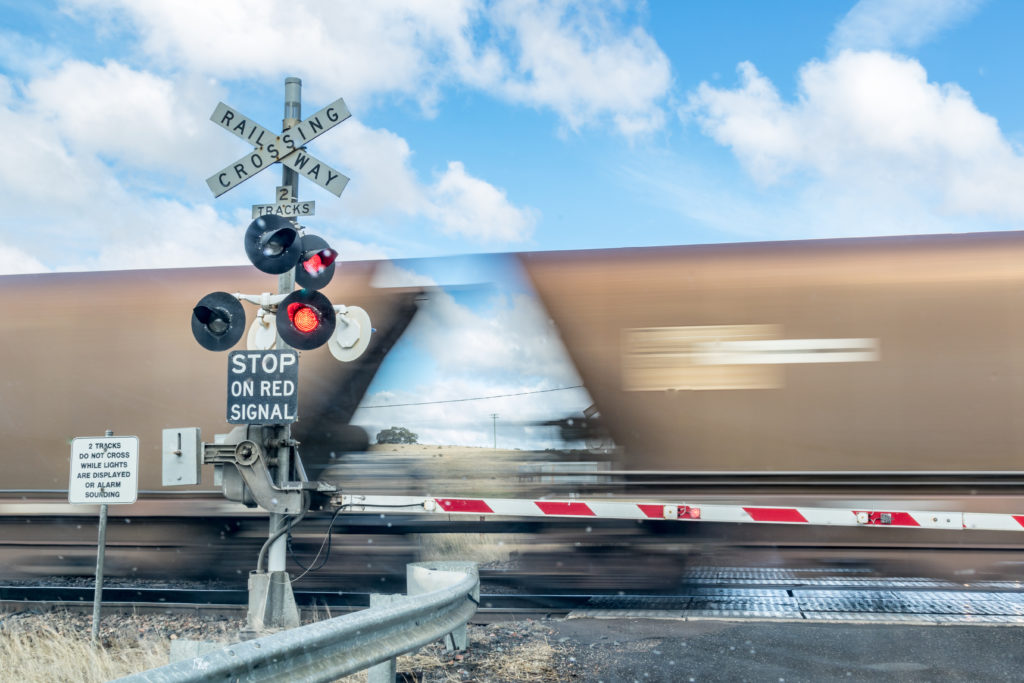
The U.S. Department of Transportation has issued a Notice of Funding Opportunity that will provide $50 million in grant funding for agencies working to boost commuter safety at highway-rail crossings.

DOT released the notice on August 25th, and explained that the funding will be awarded by the Federal Highway Administration through the Commuter Authority Rail Safety Improvement Grants Program. The Transportation, Housing and Urban Development, and Related Agencies Appropriations Act, 2020 appropriated the $50 million to be allocated through this particular program.

The Federal Highway Administration works with the Federal Railroad Administration and the Federal Transit Administration to reward commuter rail authorities’ efforts in eradicating crossing point safety hazards between railways and highways with competitive grants through the CARSI program.

“Safety is always our top priority at the department under the leadership of [Transportation] Secretary [Elaine] Chao,” said Nicole Nason, Federal Highway Administrator. “These grants will help our state, local, and regional transportation partners better protect the lives of those traveling on America’s roads and rails.”

Projects that protect or separate grades at crossings, rebuild current railroad grade crossing structures, eliminate grade crossing by relocating highways, or fix blocked grade crossings due to idling trains to eliminate hazards are eligible. An eligible commuter authority will need to have experienced an accident investigated by the National Transportation Safety Board between January 1st of 2008 and December 31st of 2018.

“FRA is always working toward a benchmark of zero fatalities at railway crossings, and such safety improvements to our nation’s infrastructure will go a long way toward that goal,” said Ronald Batory, Federal Railroad Administrator.

94% of all railway-related deaths and injuries take place at railroad crossings or are caused by trespassing, according to the FRA. Trespassing is the cause behind at least 400 rail-related deaths every year.

“Working together with FHWA and FRA, we can improve safety around highway-rail crossings and prevent collisions, injuries, and fatalities,” said K. Jane Williams, FTA Deputy Administrator. “Rail safety includes encouraging safe behavior around all rail crossings; it’s about making sure the American public is safe near all rail tracks.”

This funding opportunity has four main goals, according to the DOT. These are: to improve safety at all railway-highway crossings through the elimination of hazards in these areas, to reduce overall fatalities, crashes, and serious injuries at these crossings, to reduce the number of public at-grade crossings by either closure or grade separation, and to reduce delays and improve systems by eliminating blocked grade crossing hazards.

DOT also notes that the proposed location of an eligible project does not need to be at the location where the NTSB previously investigated a reported accident. “The proposed location of the project is up to the discretion of applicant,” DOT said.

There is also a required cost share of 10% of all project costs. Additionally, the planned type of award will be a cost-reimbursable grant agreement sent directly to the applicant or through an allocation to the applicant’s State department of transportation. The grant period of performance must be proposed by the applicant and can vary by award. DOT estimates grant awards will typically last between one and four years.

“The applicant should demonstrate the technical feasibility of the project with engineering and design studies and activities; the development of design criteria and/or basis of design; the basis for the cost estimate presented in the CARSI application, including the identification of contingency levels appropriate to its level of design; and any scope, schedule, and budget risk-mitigation measures,” explained DOT.

The current closing date for grant applications is October 26th, and the DOT will be hosting a Funding Opportunity Informational Webinar on September 10th from 2:00 PM to 3:30 PM Eastern time. This informational webinar is an attempt to help applicants fully understand all eligibility and opportunity requirements and have their questions answered.

To participate in the webinar, you must provide your name, title, organization information, and email address to Sarah.Tarpgaard@DOT.gov by September 9th. DOT also recommends you download the NOFO’s full announcement and information packet under the Related Documents tab on the grant information webpage, which you can find here.

  • Page 1
  • Page 2
  • Page 3
  • Page 4
  • Go to Next Page »

Levinson and Stefani Injury Lawyers in Chicago / Attorney Advertising